


In the highly competitive Western Canadian business landscape, physical execution serves as an organization’s ultimate differentiator. Whether a brand is launching an experiential storefront pop-up activation in the high-traffic urban corridors of downtown Vancouver or attempting to secure an eight-figure enterprise joint venture inside a vertical corporate tower in Burnaby, the physical environment dictates immediate market authority and credibility. When high-value stakeholders walk into a space, the physical environment communicates corporate capability before a single slide deck is opened.
However, taking an corporate brand identity from a digital concept screen and scaling it into a physical real estate asset is a process loaded with invisible operational friction. From aggressive municipal code enforcement to technical file errors that only surface when a graphic is blown up to architectural proportions, enterprise teams routinely run into devastating, budget-draining bottlenecks. To scale a physical footprint across the Lower Mainland without losing time or momentum, modern companies must understand the structural realities of local signage laws, bypass the technical pitfalls of DIY design templates, and convert underutilized corporate office square footage into a high-performance closing asset.
1. The Vancouver Sign By-Law Maze: Structuring Your Rollout for Compliance
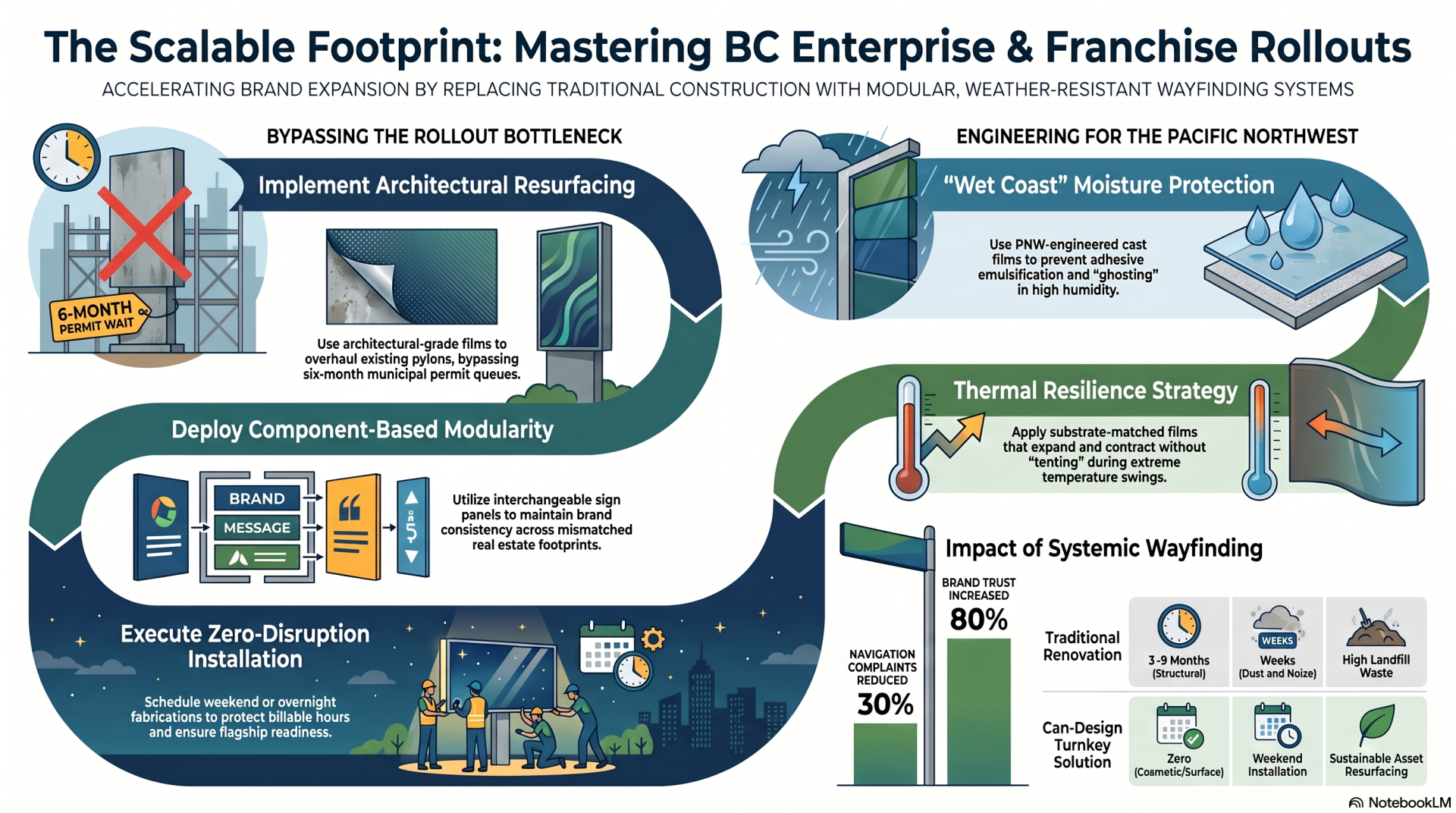
Deploying a temporary storefront pop-up, regional franchise conversion, or high-visibility corporate activation in the City of Vancouver requires navigating some of the most stringent municipal oversight in Canada. When expansion or marketing teams treat signage as a last-minute checkpoint, City of Vancouver by-law inspectors possess the authority to halt launches, issue costly compliance fines, or order the immediate removal of expensive branding materials. Adherence to the structural parameters of Vancouver Sign By-law No. 11879 is mandatory to preserve critical project timelines.
The 25% Window Area Rule and Light Transmission
A common mistake made by enterprise brands during a pop-up rollout is attempting to maximize street-level visibility by wrapping entire storefront window glass systems. In the City of Vancouver, this triggers an immediate municipal violation. By-law standards dictate that window signs cannot obscure more than 25% of any individual window pane facing a street or public path. Overstepping this strict threshold reclassifies the installation from a temporary graphic into a major architectural alteration. This automatically subjects the project to a complex development permit review that can freeze a launch timeline for months.
The Compliant Fix: Utilize strategically placed, custom-cut decal configurations or specialized frosted window films that maintain brand impact and zone compliance while fully preserving natural light transmission requirements.
The Structural Permit vs. Surface Alteration Trap
If an exterior sign installation requires intrusive mechanical fastening, drilling into structural columns, or permanent modifications to the exterior building envelope, it enters the traditional municipal permitting backlog. For brands trying to activate short-term pop-up leases or rapid fleet updates across the Fraser Valley, waiting months for an engineering permit completely destroys time-to-market advantages.
The Compliant Fix: Pivot the physical deployment strategy toward non-structural surface applications. High-tack exterior wall wraps and self-adhesive architectural films applied directly to existing substrates do not compromise the structural building envelope. They are legally categorized as surface decorations, enabling brands to bypass the permit queue and activate assets over a single weekend.
The Controlled Event Zone Regulations
During major international events or high-density summer tourism surges, the city enforces restricted “Controlled Areas” around primary commercial hubs, including downtown Vancouver corridors, BC Place, and Hastings Park. Municipal enforcement officers actively monitor these zones for “False Association.” Utilizing trademarked event phrasing or implying official corporate sponsorship on temporary exterior graphics without appropriate licensing results in rapid material confiscation and significant brand embarrassment.
The Compliant Fix: Structure the visual identity of temporary environments around thematic energy and universal graphic shorthand—such as bold color palettes, premium textures, and localized welcoming messages—rather than protected corporate trademarks.
2. The Canva Scale Trap: Why Screen Design Fails in the Real World
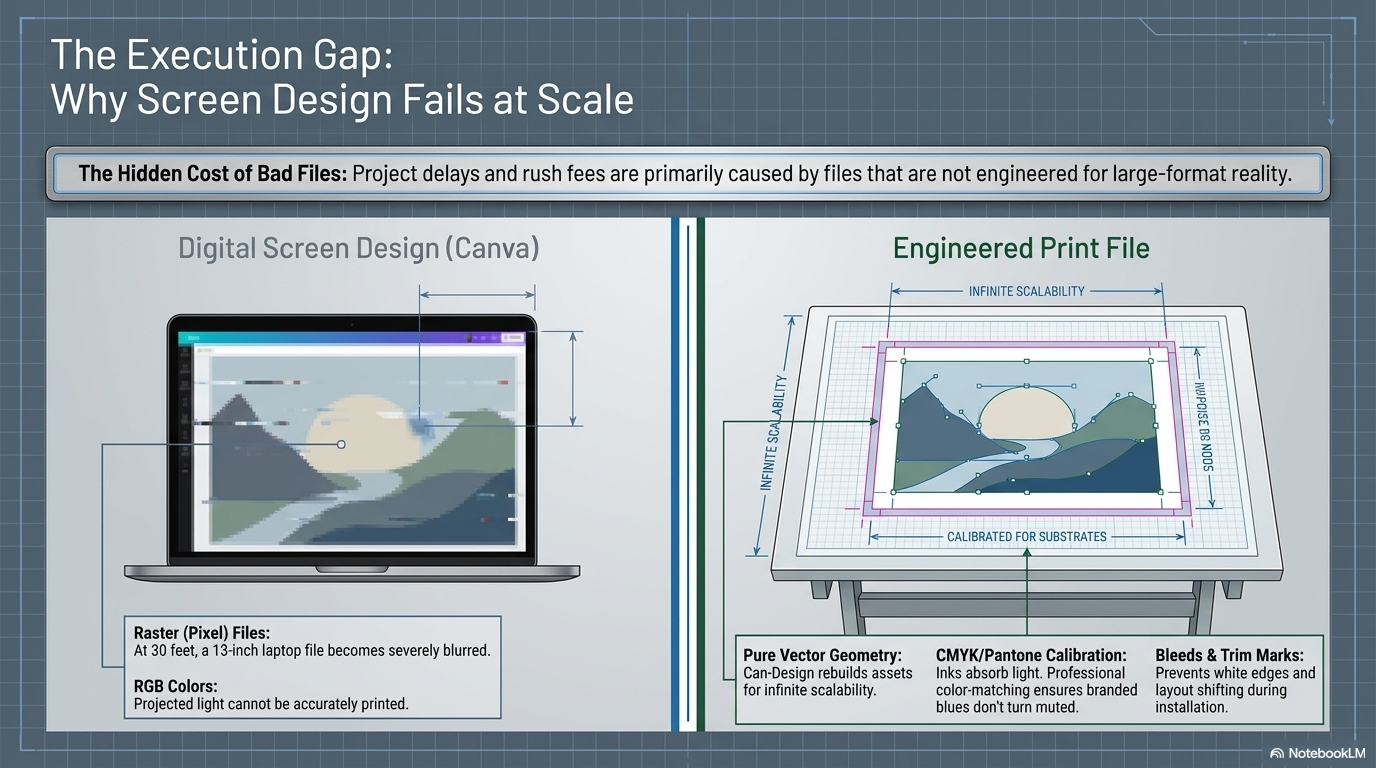
Cloud-based design applications like Canva have democratized digital layout creation, allowing in-house marketing teams to rapidly produce visual concepts on laptops or tablets. The critical point of failure occurs when these screen-optimized files are handed directly to a commercial printing press and stretched across a massive 20-foot pop-up storefront or office wall. What appears crisp on a 13-inch display frequently disintegrates into a pixelated, blurry, and highly unprofessional layout when printed at architectural proportions.
| Technical Metric | Screen/DIY Template Standard | Large-Format Print Standard |
|---|---|---|
| File Resolution | 72 DPI (Dots Per Inch) — Standard web export profiles. | 150 to 300 DPI at full physical output scale, or native vector formats (.AI, .EPS). |
| Color Profile | RGB (Red, Green, Blue) — Calibrated for projecting light on digital screens. | CMYK (Cyan, Magenta, Yellow, Black) or exact Pantone Matching Systems (PMS). |
| Spatial Psychology | Optimized for close-range reading distances (6 to 18 inches). | Scaled for structural viewing distances (10 to 50+ feet away from the asset). |
Avoiding the Canva scale trap requires technical pre-flight calibration. Large-format graphics must be engineered from native vector files or ultra-high-resolution source assets. Furthermore, failing to convert files from an RGB profile to a commercial CMYK spectrum means your approved corporate blue can easily print as a muddy, dull slate gray on physical vinyl. Finally, typography weights and contrast ratios must be adjusted to account for how a human subconsciously processes text while moving through an environment or driving down a local transit corridor.
3. The Internal Pop-Up: Converting Real Estate into a Corporate Presentation Centre
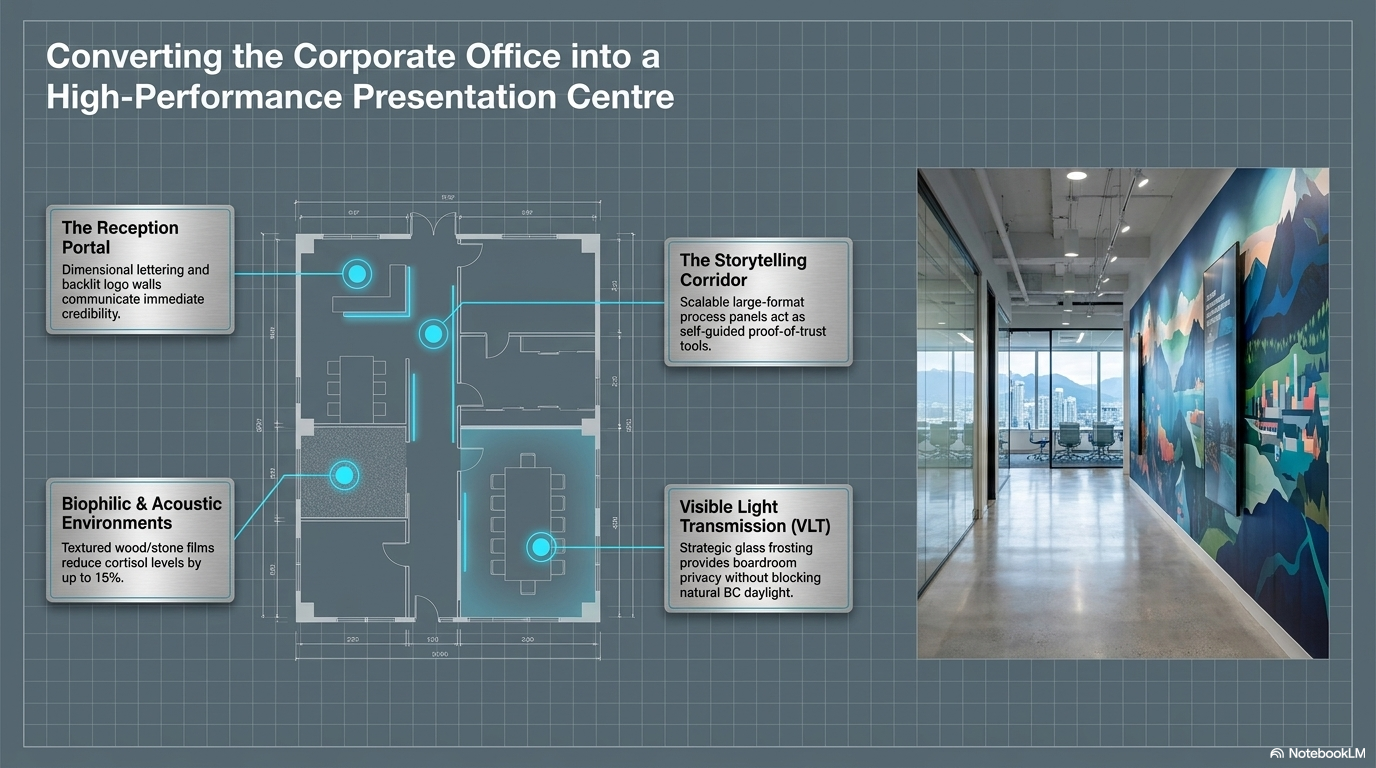
Enterprise organizations are realizing that high-velocity pop-up principles should not be restricted exclusively to retail spaces. High-growth B2B firms across Metro Vancouver are utilizing these exact same damage-free, modular visual layers internally. By executing an overnight conversion, companies are transforming standard corporate offices into high-prestige corporate presentation centres designed to win competitive contract bids, showcase case studies, and impress institutional investors.
Hosting a high-value prospect or a future lateral partner inside a boardroom that feels sterile, dated, or uninspired creates immediate environmental friction. The workspace should actively validate an organization’s professional reputation. Here is how underutilized office layouts are completely overhauled over a single weekend without construction delays:
- Overcoming the Standard Drywall and Glass Box: Standard office boardrooms often lack visual narrative and expose confidential corporate data displayed on screens to passing foot traffic. By re-skinning interior walls with premium architectural-grade wraps and applying custom-designed frosted or dusted crystal window films to glass partitions, the space transitions into a highly secure, prestige-coded presentation hub. This entire modernization occurs over a weekend, generating zero construction dust, zero paint fumes, and zero disruption to employee billable hours.
- Establishing Direct Brand Immersion: When key stakeholders visit a headquarters, the surrounding architecture must visually communicate market authority. Integrating a coordinated system of dimensional acrylic lettering, halo-lit logo anchors, and floor-to-ceiling visual milestones guides guests through an intentional narrative journey from the elevator lobby straight to the boardroom table. The office ceases to be passive square footage; it becomes an active sales tool.
Stop Ordering Signs. Start Deploying Systems.
Whether an enterprise is navigating complex City of Vancouver sign by-laws, correcting critical file resolution errors before they reach a commercial print run, or converting an existing office space into a premium presentation environment, CAN-DESIGN serves as Western Canada’s local execution authority. Every environmental graphic, architectural film, and dimensional display is manufactured directly within our local Burnaby facility, ensuring absolute quality control from initial vector configuration to final on-site installation.
Do not allow municipal red tape, production bottlenecks, or design formatting errors to compromise your next brand rollout. Secure your corporate timeline and protect your brand equity with an expert execution team that manages the entire process from compliance audit to precision deployment.
Take Action on Your Next Regional Project:
Ready to transform your physical space without construction friction or permitting delays? Let us resolve your file errors, navigate municipal hurdles, and launch your footprint on schedule.
[Book a Wayfinding and Corporate Presentation Centre Consultation with CAN-DESIGN Today]