


Why This Framework Matters
Vancouver City Council is reviewing a new Public Realm Advertising Framework (PDF). It’s meant to set clear rules for third-party advertising in public spaces. The goals are simple:
- Grow non-tax revenue for the City.
- Protect the public realm experience like streets, sidewalks, plazas, and neighbourhoods.
For businesses, media operators, and community groups, this decision could change how advertising shows up across Metro Vancouver.

The Current Landscape: Where Ads Live Today
- Street rights of way: Most ads here come from the City’s street furniture contract like bus shelters and kiosks. There are 20 digital panels downtown, with projected 2025 value at about $6.6M.
- City-owned lands: 36 billboard faces are leased out, generating about $261,000 a year.
- Private and other lands: More than 700 static billboards sit across Vancouver, many installed before the Sign By-law. Only a handful of digital boards are legal, with limited community benefit.
Why a Framework Now?
The industry is shifting to digital. One digital board can bring in eight times the revenue of a static one.
Without guiding principles, Vancouver risks patchy approvals, pushback from residents, and lost money.
This feels a lot like what we saw in our BC Liquor case study and Surrey’s signage bylaws update. If you don’t plan for consistency, you end up with a mess.
The Six Principles at the Core
The framework rests on six points:
- Ads change the public realm experience. Placement, size, and format matter.
- Offset impact with benefit. More visibility, more value to the City.
- Cap the total volume. Too many signs lower quality and reduce market value.
- Council sets the balance. They weigh impacts against revenue.
- Decisions need data. Benchmarks, safety, neighbourhood fit all count.
- Minimize local impacts. Equity and fairness should guide placement.
Challenges from Other Cities: What Vancouver Must Avoid
Other cities show why frameworks matter.
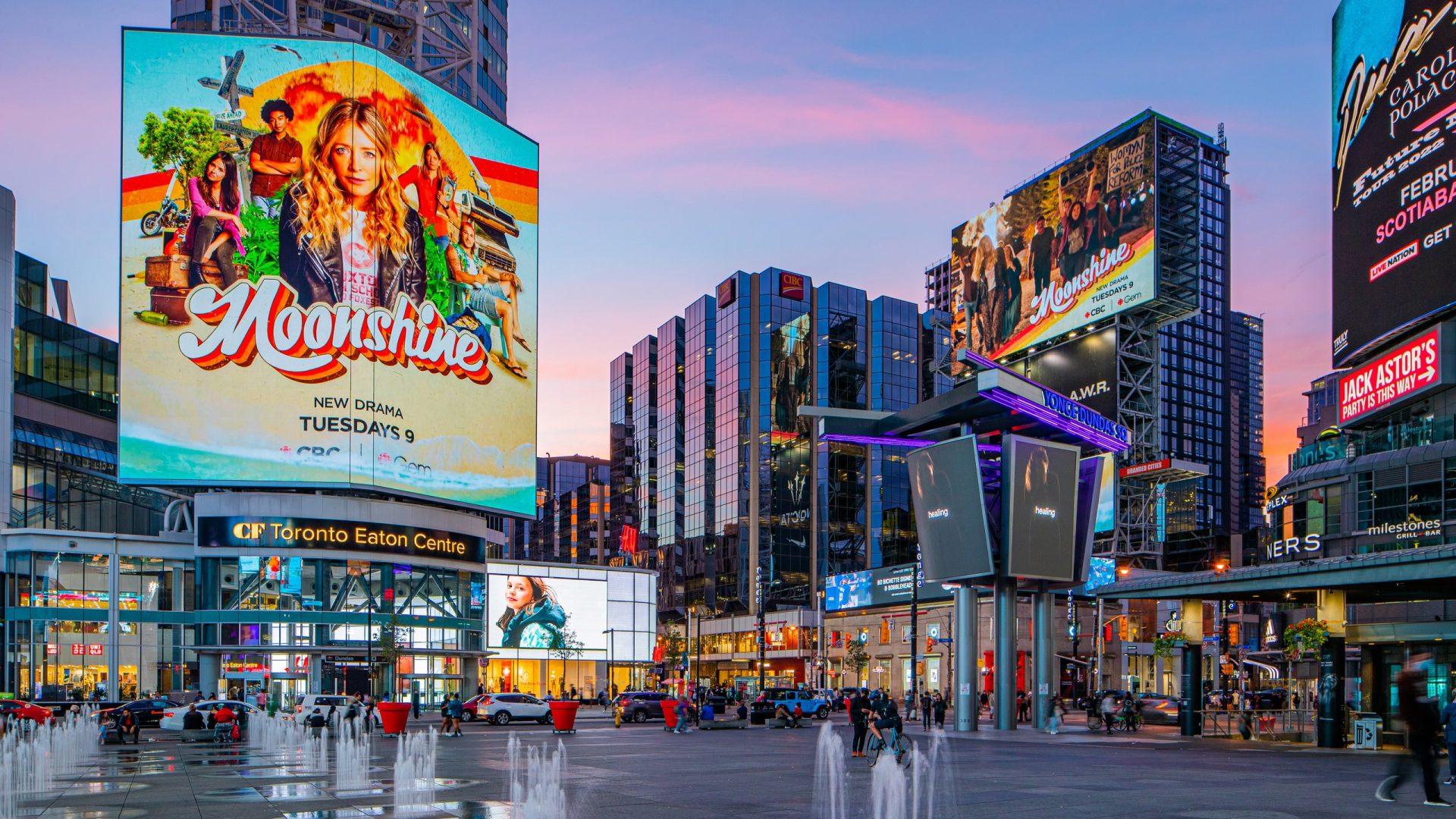
- Toronto – Struggles with visual clutter and uneven enforcement, especially along main arteries with big digital boards. Residents complain about distraction, light pollution, and changes to neighbourhood character.
- Montreal – Oversized boards in heritage districts have clashed with cultural identity. The City had to tighten rules to protect historic areas.
These examples prove that without clear rules, ads become less about strategy and more about squeezing revenue out of every wall and rooftop.
Vancouver’s First Test Case: Granville Street’s Giant Digital Screen
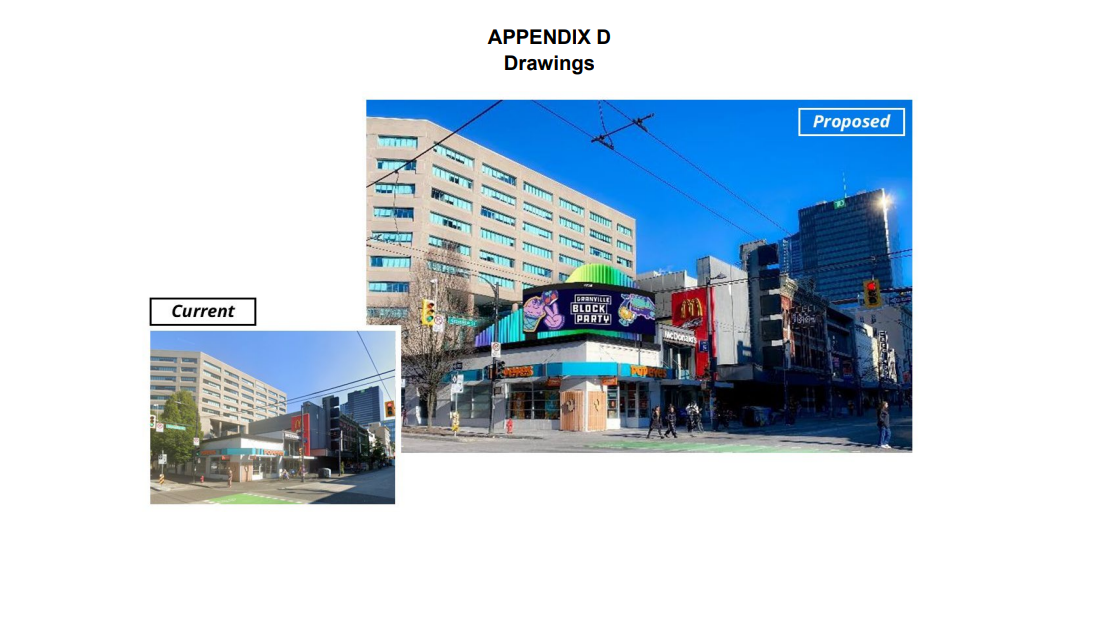
The new framework is already shaping decisions. On Sept 16, Council approved a 517 sq. ft. digital ad screen above Popeyes at 897 Granville Street.
Key details:
- Revenue: Astral will pay $80,000 a year with a 3% annual bump. By year 10 that’s over $100K.
- Revenue sharing: The building owner must now give the City half of their cut from Astral.
- Civic airtime: 20% of screen time is reserved for City uses like arts, safety alerts, or tourism. Worth about $150K–$200K a year.
Some councillors worried about driver distraction or light bleeding into nearby housing. But Council also tied the approval to the Granville Street Plan, which aims to revive the entertainment district with lighting and signage.
As Councillor Pete Fry said:
“It is a little bit, maybe more in keeping with the historical context of Granville Street, which, as we know, was once the neon highway of the city of Vancouver.”

What Happens Next
If Council adopts the full framework, staff will run a Request for Expressions of Interest for digital billboards on street rights of way. That will:
- Identify operators.
- Highlight possible locations.
- Set benchmarks for Council to work from.
Our Take at Can-Design
This is the right direction. A clear framework:
- Encourages fewer but better boards
- Adds public benefit instead of just private revenue
- Gives predictability for both neighbourhoods and operators
It also feels like a second chance. When Vancouver phased out neon decades ago, the city lost a big part of its character. Granville once had an identity that was instantly recognizable around the world.
The “death of neon” is something we’ll be covering in detail in an upcoming blog, but the lesson is already clear. If you don’t balance culture with commerce, the city loses more than it gains.
One recommendation we’d make: as Vancouver expands digital signage, it should also consider restoring neon lighting in key areas.
Not only would this align with the Museum of Vancouver’s work on preserving our neon heritage, it would bring back an authentic layer of history while complementing modern advertising.
Pairing neon restoration with a principled framework for digital screens could create a public realm that’s both forward-looking and deeply tied to local identity.
Key Takeaways
- Vancouver is moving to a principle-based system for public ads.
- The Granville screen deal shows how benefits can offset impacts.
- Digital will expand, but in a controlled way.
- The framework balances new revenue with public life quality.
???? Need signage that works with City rules and still elevates your brand? Contact Can-Design to get started.